
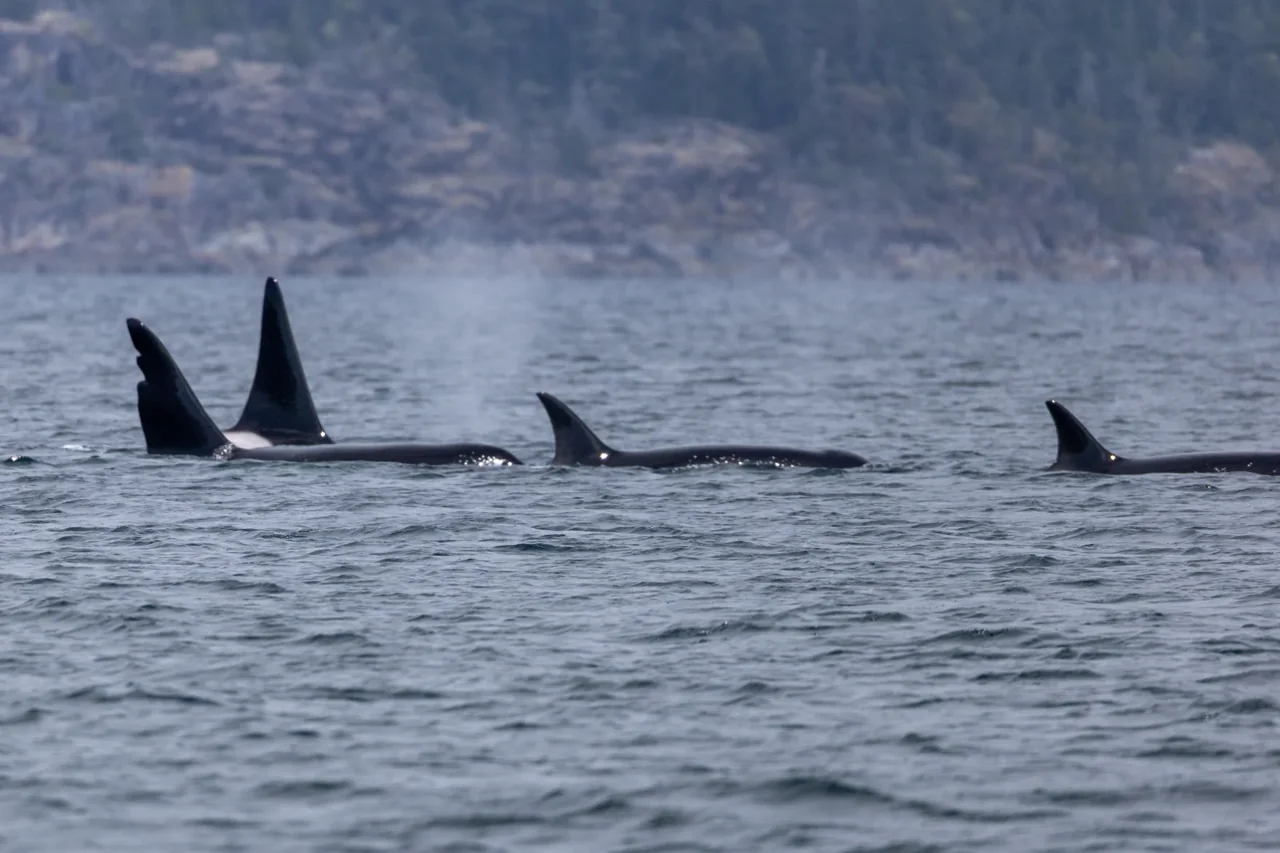
Orcas
Mammal-hunting Bigg’s killer whales travel BC’s inside waters through the year. Fish-eating Northern Residents return to nearby Johnstone Strait in summer.
Why Campbell River
Campbell River sits at the southern entrance of Discovery Passage, a narrow channel that runs between Vancouver Island and Quadra Island and links the Strait of Georgia with Johnstone Strait. Twice a day, enormous volumes of tidal water push through it, stirring up nutrients and funnelling migrating salmon past the city’s waterfront.
That richness draws humpback whales, hunting orcas, porpoises, seals, sea lions and bald eagles. Within a few hours by boat you can be weaving through the Discovery Islands, with forested shorelines and Coast Mountain peaks on every side.
Marine wildlife
Every trip is different. These are the animals most often encountered on tours from Campbell River, though their movements follow prey, tides and season, not a timetable.
Wildlife sightings are never guaranteed.
Featured tours
Make the most of your visit with a guided wildlife adventure departing from Campbell River. These two Eagle Eye Adventures experiences are our featured recommendations for exploring the surrounding coastal waters.
| Feature | 6-Hour Whale Watching | 4-Hour Wildlife Safari |
|---|---|---|
| Duration | 6 hours | 4 hours |
| Primary focus | Whales and marine wildlife | Coastal and marine wildlife |
| Naturalist guide | Yes | Yes |
| Zodiac option | Yes | Yes |
| Covered boat option | Yes | Yes |
| Refreshments | Lunch and drinks | Snacks and drinks |
| Best for | Visitors seeking more time on the water | Visitors wanting a shorter excursion |
Wildlife sightings are not guaranteed. All animals are wild and their movements vary by season, weather and natural behaviour.
Prices, departure times and seasonal availability are set by Eagle Eye Adventures. Please confirm current details on the official tour pages before booking.
Seasons
Orcas can turn up in any month, and humpbacks are most associated with the warmer months, broadly May through November. May to October is the popular window for organized tours. Remember that whale presence and tour schedules are two different things: some months have whales but few departures.
Select a month to see what wildlife may be around and how tours typically operate.
January
Coastal wildlife can still be present. The two featured tours are outside their scheduled season.
February
Bigg’s killer whales can pass through inside waters. Look for current service listings before planning a boat trip.
March
Early spring weather can vary considerably. The featured tours have later published start dates.
April
Eagle Eye lists mid-April as the start of the four-hour covered-boat safari for 2027. Confirm the calendar directly.
May
The featured four- and six-hour trips overlap, and humpbacks may be using coastal feeding areas. Check which vessels are available on your date.
June
Multiple boat options are available during the published season. Look for humpbacks and other marine wildlife as you explore the island channels.
July
Both featured durations are within their published season. Bring layers for the open water even if the weather is warm in town.
August
Humpbacks continue to use feeding waters. Confirm your vessel choice because Eagle Eye’s published covered-boat season ends in late August.
September
Both Zodiac itineraries have published September dates in 2027, with the six-hour trip finishing earlier. Check your date before making travel plans.
October
The four-hour Zodiac safari has published dates into mid-October 2027. Humpbacks can still be in coastal waters as schedules taper off.
November
The featured departure windows have ended. Marine wildlife can still be present, and coastal conditions may limit time on the water.
December
Both featured products are out of season. Winter wildlife movements are independent of the tour calendar.
General guidance from regional observations, not a forecast. Whale sightings cannot be guaranteed, and tour availability varies by operator and season.
Where is Campbell River?
Campbell River lies on the east coast of Vancouver Island, roughly halfway up the island, where the Strait of Georgia narrows into Discovery Passage. Quadra Island, the largest of the Discovery Islands, sits just across the water, a ten-minute ferry ride from downtown.
North of the city, the passage tightens at Seymour Narrows before meeting Johnstone Strait near Chatham Point. That maze of channels and islands is why whale watching near Campbell River can feel like several trips in one: open strait, tidal rapids, sheltered coves and long views to the Coast Mountains.
FAQs
The main season runs from roughly May to October, when most operators offer regular departures and humpback whales are feeding in local waters. Destination Campbell River describes the broader Vancouver Island season as centred on April to October. The shoulder months can be rewarding too: the herring spawn in late February and early March draws orcas and humpbacks, and fall salmon runs concentrate wildlife when boats are quieter. Bigg’s killer whales can appear in any month, but tours outside summer are limited, so confirm schedules first. Our month-by-month guide has the detail.
The whales most often seen are humpbacks and killer whales. Bigg’s killer whales, which hunt seals, sea lions and porpoises, travel these inside waters throughout the year, while fish-eating Northern Resident killer whales use nearby Johnstone Strait in summer. Minke whales are seen occasionally, and gray whales are sometimes reported in spring as they migrate north, although most stick to the outer coast. Tours also regularly meet Pacific white-sided dolphins, Dall’s and harbour porpoises, harbour seals, Steller and California sea lions, and bald eagles. Our Marine Wildlife guide covers each species.
Yes, orcas are encountered around Campbell River, though never on a schedule. Bigg’s (transient) killer whales hunt marine mammals throughout BC’s inside waters, and UBC researchers report they are now seen there on roughly 250 days of the year. In summer, Northern Resident killer whales return to Johnstone Strait, north of Discovery Passage, typically from late July. Because orcas range so widely, a longer outing such as the 6-Hour Whale Watching Tour gives more time to search, but no operator can promise a sighting.
Your chances are good in the main season, but whales are wild animals and no sighting is guaranteed. Humpbacks have made a strong comeback on the BC coast since commercial whaling ended, and Bigg’s killer whales are far more frequent in inside waters than a few decades ago, both of which help. Results still vary with tides, weather, prey and the animals’ own movements, and some trips see more seals, sea lions, dolphins and eagles than whales. Ask your operator about its policy if no whales are seen, and treat every encounter as a gift rather than a promise.
It’s one of the best-placed towns on Vancouver Island for it. Campbell River sits at the south entrance of Discovery Passage, a channel about 25 km long between Vancouver Island and Quadra Island that links the Strait of Georgia with Johnstone Strait. Tidal currents reaching 16 knots in Seymour Narrows stir nutrients through the channel, and migrating salmon funnel past, drawing whales, seals, sea lions and eagles. Within a few hours by boat you can reach the Discovery Islands, so a single tour covers remarkably varied coastline. Destination British Columbia lists Campbell River among the province’s top whale watching areas.
A Zodiac is an open, rigid-hulled inflatable boat: quick, low to the water and exhilarating, with every seat close to the action. You’ll wear a flotation suit and should expect wind and some spray. A covered boat has a sheltered cabin, so you can step out of the weather, and it suits young children, older travellers and anyone who feels the cold; Eagle Eye’s covered-boat listings also mention an onboard washroom. Both follow the same federal viewing rules. Choose a Zodiac for adventure and a covered boat for comfort. Both featured tours offer either option.
It depends on your time and priorities. A four-hour trip such as the 4-Hour Marine Wildlife Safari is a strong introduction, covering Discovery Passage and nearby channels with time for whales, porpoises, seals, sea lions and eagles. A six-hour tour gives the naturalist more range and patience to follow wildlife further afield, and includes lunch. If whales are your main goal and you can spare the day, the longer trip offers more opportunity. If you’re travelling with children or on a tight schedule, the shorter one is easier to fit in.
Many families whale watch here, but age and size limits vary by operator and by boat. Zodiac tours often have minimum ages or heights because guests wear flotation suits and need to hold on during faster travel, while covered boats are usually better for younger children. Check the current policy on the Eagle Eye Adventures tour page before booking. Pack snacks, warm layers and something to keep little ones busy during quieter stretches of searching, and consider the shorter four-hour tour if you’re unsure how long they’ll stay engaged.
Dress warmer than you think you need. Even on sunny summer days, the wind on the water can feel much cooler than on shore. Wear layers, such as a thermal base, a fleece or wool mid-layer and a waterproof shell, plus a warm hat and closed-toe shoes. Bring sunglasses with a strap, sunscreen, a water bottle and any seasickness remedy you rely on. Binoculars and a camera with a zoom lens help at legal viewing distances. Operators usually supply flotation suits on Zodiacs, but confirm what’s included. Our packing checklist has more.
In BC’s Pacific waters, keep at least 200 m from killer whales and 100 m from most other whales, dolphins and porpoises, or 200 m if they are resting or with a calf. A separate measure requires 1,000 m from Southern Residents in designated waters through May 31, 2027, with exceptions. Check current Fisheries and Oceans Canada guidance before going on the water.
Still planning? Browse more trip-planning questions or compare the featured tours.


